 Labradoodle House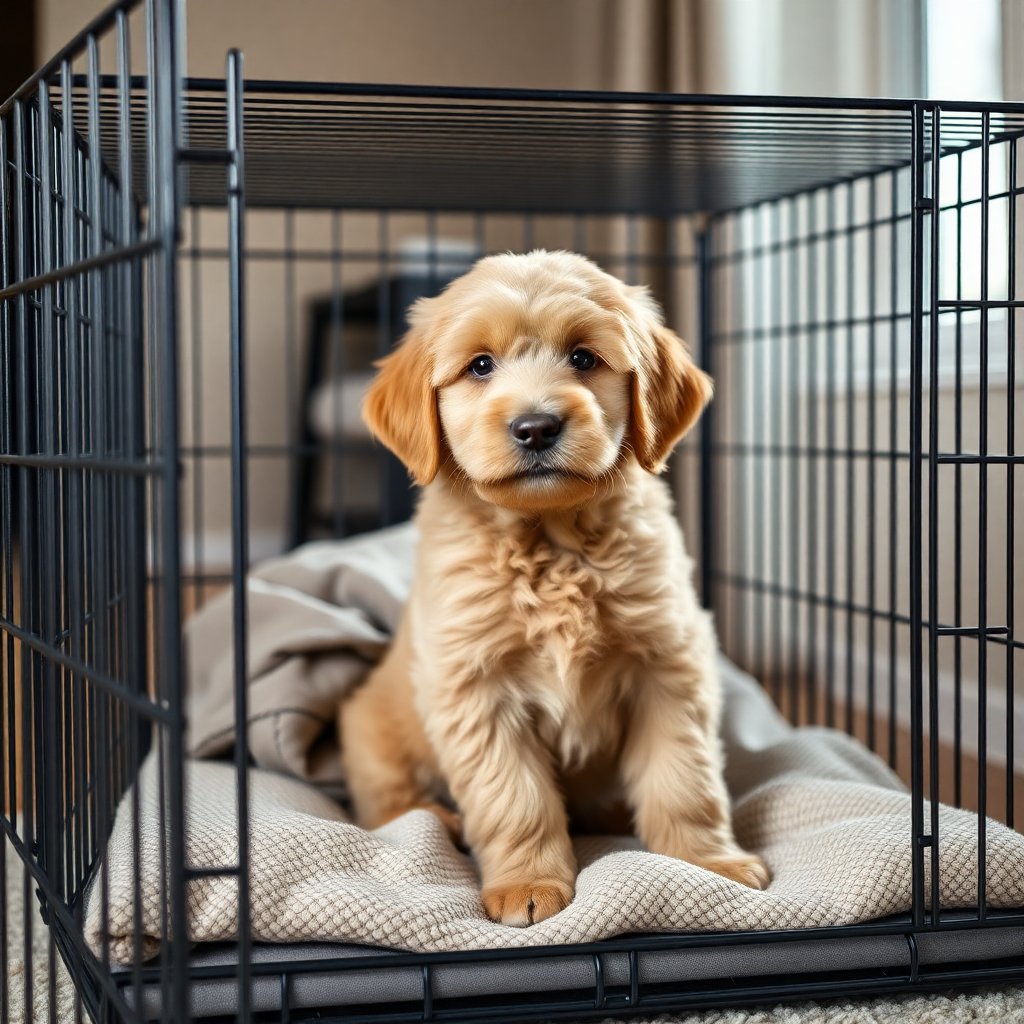
Labradoodles are smart, social, and occasionally destructive — especially when they're bored, anxious, or teething through their first year. A good crate isn't a punishment tool; it's a safe space that makes housetraining faster, travel safer, and separation anxiety more manageable. But picking the wrong size or style for a doodle is a common (and expensive) mistake.
Why Crate Selection Matters for Labradoodles
If you've owned a Labradoodle for more than a few weeks, you already know they're not a low-key breed. They inherit the Poodle's intelligence and the Lab's energy, which means they need structure and mental stimulation — and a crate is one of the simplest tools in the toolkit.
Size range is a real challenge. Miniature Labradoodles run 15–25 lbs, mediums land around 30–45 lbs, and standards can push 50–80 lbs. A crate that works for a mini will be comically small for a standard, and an oversized crate defeats the purpose for housetraining. You need a crate where your dog can stand up, turn around, and lie down comfortably — but not much more than that during the training phase.
Doodle puppies are escape artists. That Poodle intelligence shows up in crate behavior. Labradoodle puppies will test latches, push panels, and figure out weak points in cheap crates within days. Flimsy wire crates with single-latch doors are a false economy — a determined doodle puppy can bend thin-gauge wire and injure themselves in the process.
Coat and temperature matter. Labradoodles with thicker, curlier coats overheat easily in enclosed plastic crates, especially in warmer climates. Wire crates with good airflow are usually the better default unless you're traveling by air.
Pairing the right crate with solid leash training and a quality harness gives you a complete foundation for a well-adjusted doodle.
The Best Dog Crates for Labradoodles in 2026
1. MidWest iCrate Double Door — Best Overall Wire Crate
The MidWest iCrate has been a staple for dog owners for years, and for good reason. It comes with a divider panel, which is essential for Labradoodle owners — you can section off the crate while your puppy is small and expand it as they grow, saving you from buying multiple crates. The double-door design (front and side access) makes placement flexible in any room.
For standard Labradoodles, go with the 42-inch model. Medium doodles do well in the 36-inch. The fold-flat design is genuinely useful if you travel or need to store it seasonally, and the slide-out plastic pan makes cleanup simple after the inevitable puppy accident.
The wire gauge is sturdy enough for most Labradoodles, though truly determined chewers or dogs with severe separation anxiety may need something heavier. For the vast majority of doodle owners doing standard crate training, this is the right starting point.
→ Shop MidWest iCrate Double Door on Amazon
2. Diggs Revol Dog Crate — Best Premium Wire Crate
The Diggs Revol is what you get when someone redesigns the wire crate from scratch. The build quality is noticeably better than traditional wire crates — reinforced steel wire, a diamond-shaped mesh pattern that's harder for dogs to get their teeth on, and a ceiling hatch that doubles as a puppy playpen gate. It also includes a divider for growing puppies.
The standout feature is the collapsible design with a single-action fold. Unlike traditional wire crates that require you to fight with multiple clips, the Revol folds and unfolds in seconds. If you're traveling with your Labradoodle regularly or moving the crate between rooms, this convenience adds up fast.
It's significantly more expensive than the MidWest, so it's not the right pick if you're on a tight budget. But if you want something that looks decent in your living room, travels well, and is genuinely built to last through the puppy stage and beyond, it earns its price.
→ Shop Diggs Revol Dog Crate on Amazon
3. Impact Dog Crate Collapsible — Best Heavy-Duty Option
If your Labradoodle has serious separation anxiety or has already broken out of a standard wire crate, the Impact Collapsible is built for exactly this scenario. It's constructed from aluminum with reinforced steel latches — this is the crate that trainers and behaviorists recommend for dogs that bend wire and pop latches on conventional setups.
The ventilation is excellent for a heavy-duty crate, with perforated aluminum panels on all sides keeping airflow steady even for thick-coated doodles. It's also airline-compliant in most configurations, which matters if you fly with your dog.
The trade-off is weight and price — it's heavy and it's not cheap. But for the subset of Labradoodle owners dealing with destructive crate behavior, this solves the problem permanently. It's also a common choice for owners who compete in agility or rally and need a reliable travel crate that can take a beating.
→ Shop Impact Dog Crate Collapsible on Amazon
4. Petmate Ultra Vari Kennel — Best for Air Travel
If you need a crate specifically for flying, the Petmate Ultra Vari Kennel is the standard. It meets IATA airline requirements, has a secure locking system with squeeze latches that dogs can't pop, and provides adequate ventilation through the side vents. The 500 series (40" x 27" x 30") fits most standard Labradoodles comfortably.
For everyday home use, a wire crate is usually better due to airflow and visibility. But if air travel is in your plans — whether it's a cross-country move or regular trips — having an airline-approved crate you've already acclimated your dog to is essential. Don't wait until two days before a flight to introduce a plastic kennel to a dog that's only known wire crates.
One tip: measure your specific Labradoodle and check with your airline before purchasing. Size requirements vary between carriers, and a crate that's too small will get rejected at the gate.
→ Shop Petmate Ultra Vari Kennel on Amazon
5. EliteField 3-Door Folding Soft Crate — Best Soft-Sided Option
Soft crates aren't for puppies or untrained dogs — let's get that out of the way first. But for adult Labradoodles who are already crate-trained and calm, the EliteField 3-Door is a fantastic travel and camping option. It weighs a fraction of a wire crate, sets up in seconds, and folds into a carry bag.
The three-door configuration (front, side, and top) gives you flexible access, and the steel frame provides enough structure to keep its shape. The mesh panels offer decent airflow, and the fabric is washable. For road trips, vet visits, or just having a portable safe space at a friend's house, it's hard to beat.
The key caveat: if your Labradoodle is a chewer, a scratcher, or has any anxiety around confinement, a soft crate will last approximately one unsupervised session. This is strictly for dogs who view their crate as a relaxation spot, not a prison to escape from.
→ Shop EliteField 3-Door Soft Dog Crate on Amazon
6. New World Double Door Dog Crate — Best Budget Pick
The New World crate is MidWest's budget-friendly alternative and it covers the basics well. It includes a divider panel, fold-flat design, and a leak-proof plastic pan. The construction is lighter-gauge wire than the iCrate, but for a calm Labradoodle or one that's past the destructive puppy stage, it does the job at roughly 30% less cost.
The 42-inch model fits standard Labradoodles, and the 36-inch works for mediums. If you're buying a crate for a second room, guest house, or grandma's place and don't need the most robust build, this is a smart way to save without compromising on the features that matter.
→ Shop New World Double Door Dog Crate on Amazon
What Size Crate Does a Labradoodle Need?
Getting the size right is the single most important decision. Here's a quick guide:
- Miniature Labradoodle (15–25 lbs): 30-inch crate
- Medium Labradoodle (30–45 lbs): 36-inch crate
- Standard Labradoodle (50–80 lbs): 42-inch crate
- Large Standard Labradoodle (75+ lbs): 48-inch crate
If your Labradoodle is still growing, buy the adult-appropriate size and use a divider panel. This lets the crate grow with your dog and keeps the space appropriately sized for housetraining — puppies in oversized crates will use one end as a bathroom and the other as a bedroom, which defeats the purpose entirely.
Comparison Table
| Product | Best For | Price Range | Rating | |---|---|---|---| | MidWest iCrate Double Door | Overall wire crate, growing puppies | $40–$70 | ⭐⭐⭐⭐½ | | Diggs Revol | Premium build, frequent travelers | $150–$275 | ⭐⭐⭐⭐⭐ | | Impact Collapsible | Escape artists, heavy-duty needs | $350–$600 | ⭐⭐⭐⭐½ | | Petmate Ultra Vari Kennel | Air travel, airline compliance | $70–$120 | ⭐⭐⭐⭐ | | EliteField 3-Door Soft Crate | Trained adults, portable use | $35–$65 | ⭐⭐⭐⭐ | | New World Double Door | Budget-friendly everyday crate | $30–$50 | ⭐⭐⭐⭐ |
Crate Training Tips for Labradoodles
No crate works if the introduction is rushed. Labradoodles are sensitive dogs — force them into a crate and slam the door, and you'll create a crate-averse dog that howls for hours. Here's what works:
Start slow. Leave the crate open with a treat or Kong inside. Let your doodle explore on their own terms. Don't close the door until they're voluntarily walking in and hanging out.
Build duration gradually. Five minutes with the door closed, then ten, then thirty. Don't jump from zero to a full workday. If your dog is distressed, you've moved too fast — back up a step.
Never use the crate as punishment. The crate should be associated with good things — treats, chew toys, nap time. If you send your Labradoodle to the crate after they chew a shoe, you're poisoning the association.
Exercise first. A tired doodle is a calm doodle. A brisk 30-minute walk or play session before crate time makes the transition dramatically smoother. Trying to crate an under-exercised Labradoodle is an exercise in futility.
→ Shop Kong Classic Dog Toy on Amazon
Frequently Asked Questions
How long can a Labradoodle stay in a crate?
Adult Labradoodles can handle 4–6 hours in a crate, but pushing beyond that regularly isn't fair to the dog. Labradoodles are social breeds that bond deeply with their people — extended isolation leads to anxiety, excessive barking, and destructive behavior. Puppies need out even more frequently: a good rule of thumb is one hour per month of age, plus one. So a 3-month-old puppy maxes out at about 4 hours. If your workday is longer than 6 hours, consider a dog walker, doggy daycare, or an exercise pen setup instead of extended crating.
Should I cover my Labradoodle's crate at night?
Many Labradoodle owners find that a crate cover helps their dog settle at night, especially during the first few weeks of crate training. Covering the crate reduces visual stimulation and creates a den-like environment that most dogs find calming. Use a breathable blanket or purpose-made crate cover — avoid anything that restricts airflow, especially for thick-coated doodles who already run warm. If your dog seems agitated with a cover, leave one side open or skip it entirely. Every dog is different.
→ Shop Dog Crate Cover on Amazon
When can I stop crating my Labradoodle?
Most Labradoodles can transition out of mandatory crating between 12 and 24 months, depending on their maturity level and destructive tendencies. The key milestone is consistent behavior when you're away — if your doodle can be left in a puppy-proofed room for an hour without destroying anything or having an accident, you can start extending unsupervised free-roam time gradually. Many owners keep the crate available with the door open permanently, and their Labradoodle continues choosing it as a nap spot well into adulthood. There's no reason to remove a crate your dog likes.
Wire crate or plastic crate — which is better for a Labradoodle?
Wire crates are better for most Labradoodle owners. They provide superior airflow — critical for a breed with dense, insulating coats — and give your dog full visibility of the room, which reduces anxiety for social breeds. Wire crates are also easier to clean, fold flat for storage, and usually come with divider panels. Plastic crates make sense primarily for air travel or for dogs that feel more secure in an enclosed space. If your Labradoodle isn't flying anywhere, start with wire.
Can two Labradoodles share a crate?
No. Each dog needs their own crate. Even if your two doodles are best friends, sharing a crate creates resource guarding risks and doesn't give either dog a true safe space. Crates are meant to be a personal retreat, and doubling up defeats that purpose entirely. If space is an issue, consider stackable crate configurations or an exercise pen for shared downtime.
→ Shop Dog Exercise Pen on Amazon
Final Thoughts
For most Labradoodle owners, the MidWest iCrate is the right starting point — it's affordable, includes a divider for growing puppies, and handles the daily demands of crate training without fuss. If you want a premium upgrade that travels better and looks sharper, the Diggs Revol justifies its higher price. And if your doodle has proven they can break out of anything, the Impact Collapsible ends the escape game for good.
Whatever you choose, invest the time in proper crate training. The crate itself is just metal and plastic — it's the routine and positive associations you build around it that make the difference for your Labradoodle.
As an Amazon Associate we earn from qualifying purchases. This article contains affiliate links; if you buy through them we may earn a small commission at no additional cost to you.